2008-08-20

Mentor-Graphics-PADS-2007.3


Mentor Graphics Corporation, (NASDAQ: MENT), the market and technology leader in printed circuit board (PCB) design solutions, announced the availability of the PADS I/O Designer(TM) product specifically targeted at its PADS(R) product user community. For designers implementing complex field-programmable gate arrays (FPGAs) on their PCBs, the I/O Designer(TM) product has a proven track record of decreasing design cycle time, improving performance, and lowering product costs. These same benefits are now available to the PADS product users at an aggressive entry price as the use of high density, high performance FPGAs increases across the spectrum of electronic products. For the first time the PADS I/O Designer product is being made available to the PADS community.


"Mentor Graphics has demonstrated exceptional productivity benefits in optimizing the FPGA-to-PCB integration process with I/O Designer," said Danny Biran, Altera's senior vice president of product and corporate marketing. "The introduction of I/O Designer for PADS will bring the benefits of cycle time reduction and lower PCB costs to a broader FPGA / PCB customer base. Altera's advanced FPGA technology, combined with I/O Designer for PADS, is a perfect solution for the PADS user to expand their mainstream FPGA usage."

"Providing an industry-leading integrated and concurrent FPGA / PCB design process has been a major benefit to our customers," said Henry Potts, vice president and general manager of Mentor Graphics' Systems Design Division. "Users of high-end FPGAs report time-to-market reduction and systems performance improvement of up to 50 percent, and reductions in PCB layer counts resulting in reduced product costs. With the continuing trend in electronic products of using even more high-end FPGAs, the impact of providing I/O Designer to our PADS users is significant."

The PADS I/O Designer Product
The PADS I/O Designer family provides for concurrent design of the FPGA and PCB by bridging these unique design flows and automating the various processes needed to implement today's high pin-count, high-speed FPGAs on PCBs. Starting with nothing or an early hardware design language (HDL) description or a top-level DxDesigner(TM) product, the FPGA-PCB interface is quickly defined with a variety of correct by construction, drag and drop PCB signal to FPGA pin assignment methods. The PADS I/O Designer product then synchronizes the interface across the FPGA and PCB flows through:

Automatic DxDesigner and schematic generation
Automatic generation & maintenance of required FPGA vendor files, HDL files, and synthesis constraint files
Optionally, the PADS I/O Designer product will import the PADS Layout physical design for FPGA vendor rules-driven pin swaps. When extended to PCB optimization, the PADS I/O Designer product leverages the PADS Layout physical design to drive PCB trace optimization through FPGA interface unraveling. Also available is functionality to optimize multiple FPGA interfaces simultaneously within a single PADS Layout physical design.

2008-08-14

Mastercam.X3


What’s Coming in Mastercam X3?
T he release of Mastercam X3 is right around the corner, so we want to provide you with a peek at
some of the hot features that Mastercam X3 will be delivering to you!
Mastercam Mill
• Feature Based Machining – Mastercam’s new FBM (available for Mill Level 1 and higher) makes it
significantly easier to machine prismatic solids by automating the machining process. FBM offers
shops dramatic reductions in programming time by automatically evaluating a solid part and
programming pockets, contours, bosses, and drilling routines with minimal user input. It even
chooses appropriate tools from a list of preferred tools or libraries.
• 2D High Speed Toolpaths – A new entry to the Toolpaths menu, 2D High Speed is set of five
toolpaths optimized for high speed and hard milling. These new toolpaths use a new interface that
will eventually be expanded to include all toolpaths in the future.
• Multiaxis – General speed improvements were made in the processing time of the Multiaxis
toolpaths.

Mastercam Lathe
Tool Catalog and Library Changes –Sandvik and Kennametal® tool catalogs have been completely updated
and rebuilt. A new VTL right turret tool library was added with some basic tooling correctly oriented.

Mastercam Wire
Multiple 4-Axis Wirepaths in One Operation – You can now combine multiple 4-axis wirepaths in a single
operation by using appropriate chaining and point selection techniques.

Please remember, this is only a smal sampling of the new features that X3 has to offer – there are


important enhancements in all products. Look for the 3rd Quarter Customer Newsletter, our X3 focus issue!astercam’s Advanced Multiaxis Tools Mastercam has powerful Advanced Multiaxis
tools that you will find extremely useful when faced with generating toolpaths for 5-axis
machines.Plunge Roughing – Plunge roughing is an excellent way of removing material when you
need to use long tools. You can plunge rough in layers, picking away at material with much less
side deflection forces than conventional multi-pass operations.

Stock Recognition – This feature can really save you time. It is simple to
use and works every time! The toolpath is trimmed to the stock boundary,and you can even extend
it either by a percentageof the cutter diameter or by a specific value.Stock Recognition works
with every roughing method, including plunge roughing. One Mastercam customer shaved 60%
off cycle time on roughing one of their impellers by using the Stock Recognition feature.

Govern Cut Pattern – Mastercam has the ability to govern the cut
pattern by one set of surfaces, while cutting another. In this example,
the hub surface is used as the cut pattern. The blade surfaces are
the driver surfaces, but all cuts are parallel to the hub.
Dynamic Tool Axis Control – In the previous example, the drive surfaces are the blade and
the fillets between the blade and hub. The blade is warped, so you can use a Swarf cut. A tapered
ball nose cutter is preferred for rigidity. You can specify a side tilt angle you wish to maintain, but that would not work well on the fillet. Mastercam’s Advanced Multiaxis tools let you tilt away with a lead/lag or side tilt angle if any part of the tool (cutter, shank, arbor, or holder) gets within a specified range of any drive or check surfaces.

Morph Between 2 Curves – This very versatile toolpath strategy can be used on many different
parts.

Dynamic Incremental Tool Axis Change – This feature lets you machine the part completely in
one shot. Cuts Along Curve – You can create a line, arc, chain, or spline. Your cut pattern will be the result of perpendicular slices to it along the drive surfaces. When you are cutting ports, you don’t need to split your surfaces from one side to the next. You can simply create a spline and break it to control how far you wish to cut from either side.

2008-08-09

Dynavista-v8.5 for catia v5


Dynavista
With its unique technology, Dynavista brings innovation to the design through manufacturing process for all types of stamping die and molding die. By seamlessly integrating die design and die manufacturing, Dynavista speeds development time and guarantees high quality results. Numerous Japanese automotive OEMs and toolmakers have proved the integrated die and engineering system to work. Dynavista modules include Die Face Design, Press Die Structure Design, Mold Design and 3D Axis Die CAM & 2.5D Axis Die CAM.
A hybrid specification driven modeling system, Dynavista unifies the feature platform and user interface for all applications to allow for the controlled propagation of design intent. Built on Dassault Systemes’ CAA V5 architecture, Dynavista facilitates end-to-end die development and complements other V5 automotive applications. Dynavista enables manufacturers to capture, share and reuse information across the global manufacturing environment, as well as to extend the system to the vast supplier network worldwide. Dynavista allows manufacturers to embed expert know-how into the product with the knowledgeware technology in the V5 environment. Dynavista also manages design rules and formulas to ensure design compliance.
Nihon Unisys, maker of Dynavista, is a recognized leader in Japan, delivering CAD/CAM solutions and consulting services to the automotive industry for the past 30 years. Dynavista enables

2008-08-04

LightTools 6.1


Optical Research Associates

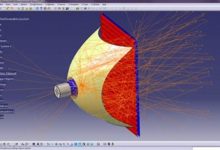
Optical Research Associates (ORA), the Californian-based optics company, has released LightTools 6.1, an illumination design and analysis software. The software includes advanced modelling and analysis features that facilitate the design of sophisticated luminaires, LEDs, and displays. For instance, the Ray Path feature allows identification of exactly what system elements are contributing to light loss, scatter, unintentional reflections, or ghost images. This is particularly useful in the design of stray-light sensitive systems, such as microlithography steppers or astronomical instruments.

LightTools also supports accurate modelling of scattering surfaces by allowing users to apply measured BSDF data (both isotropic and anisotropic) to a surface. Additionally, the software comes with a library of BSDF data of reflective materials most commonly used in luminaire construction, including those available from companies such as Alanod and Almeco. Support for gradient index (GRIN) lenses has also been added, including radial, axial, spherical, and user-defined gradients.

Accurate modelling of LEDs with LightTools has been further extended with new ways to specify the properties of phosphors. In particular, the mean free path (the average distance that a ray will travel in a material before striking a phosphor particle) can now be described as a constant, as a wavelength-dependent quantity, or by using Mie scattering theory.

LightTools' ease of use has been enhanced with expanded foreign language support. Specifically, menus and dialogue boxes are now available in French, German, simplified Chinese, traditional Chinese, and Korean, in addition to Japanese, which has long been included in the software.

2008-08-02

ANSA-V12.1.4 (C)-BETA-CAE

ANSA is an advanced CAE pre-processing tool for Finite Element Analysis that provides all the necessary functionality for full-model build up, from CAD data to ready-to-run solver input file, in a single integrated environment. ANSA is the users' favorite, due to its wide range of features and tools that meet their needs. The list of productive and versatile ANSA features is long and the alternative tasks and processes to be completed using them are countless.

CAD data Input
CAD geometry can be read in from neutral files (IGES, VDA-FS, STEP, etc.) and manipulated by ANSA's powerful built-in geometry engine. Additionally, data files in CATIA V4, CATIA V5, NX, Pro/ENGINEER and JT formats can be converted into ANSA files using the available translators.

ANSA Data Management
ANSA DM assures the effective and efficient data handling throughout projects, by streamlining updated model data to engineering teams, allowing the easy sharing of common data and offering the access to library items for the analysis dependant solution settings.

Task Manager
Integrated workflow manager. A tool where all individual tasks of the development of a vehicle simulation model are included. Tasks in Task Manager are built up from the CAE expert who sets the boundaries between distinct modeling actions and predetermines all modeling parameters that must be respected, leaving to the inexperienced user a minimum degree of interference and limited (or none) decision making.

Meshing
Following the versatile mesh area idealization, geometry can be meshed according to modeling requirements by its cutting edge, fully integrated surface and volume meshing algorithms.
The numerous proprietary shell meshing algorithms, the high performance and quality Tetra meshing algorithms, the Hexa-Interior meshing algorithm and the Acoustic Cavity mesher create a unique mesh generation environment.
Furthermore, the integrated batch meshing tool leads to controllable and effortless optimal meshing results.

Assembly
Powered with fully comprehensive parts and welding management tools, ANSA facilitates parts assembly, with alternative node-dependent or -independent connections types. The advanced exchange of connections data through vip, vip2 and xml files succeeds in the completion of a single stage parts connection.
New concepts introduced, including model hierarchy input, multiple part instances handling, alternative part representations management, model assembly and build up using Generic Entities such as Connectors, Boundary Conditions and Output requests.

Preprocessing Decks
Preprocessing completion is achieved through the uniquely interoperating preprocessing decks for NASTRAN, LS-DYNA, PAM-CRASH, RADIOSS, ABAQUS Standard/Explicit and ANSYS, allowing direct model modification between solvers, including material synchronization. ANSA is multidisciplinary by design, in order to simultaneously handle models for Crash, Durability, NVH, CFD analysis etc., supporting all entities required by various solvers.
Numerous quality and integrity checks and fixes assure model quality before output.

Models reusability
Legacy FE Models can also be read in various formats and optionally refined or coarsened by the automated mesh reconstruction functionality, which has incredible capabilities. The FE models can even be modified further with a wide range of preprocessing decks functions and tools.

Safety features
Crash and safety modeling is assisted by user friendly features for seatbelt fastening, positioning and articulation of crash test dummies and "headform" models for passenger and pedestrian safety simulation standard scenarios.

Laminates
The Laminate Tool is one more enhanced function that assists the modeling of complex parts made of composite materials.

Model integrity checks
Replicating the integrity and correctness checks performed by the solvers, ANSA reports potential modeling flaws and proceeds to model auto-correction actions.

Solution control
The above, along with the user-friendly solution case scenario definition leads to the output of a ready to solve model. Apart from the formats of the solvers for which complete preprocessing decks exist, i.e. NASTRAN, LS-DYNA, PAM-CRASH, RADIOSS, ABAQUS and ANSYS, numerous other file formats are supported, for structural, CFD and other solvers.

Tools
The core preprocessing functionality of ANSA is enhanced with a substantial number of other advanced tools that allow the user to complete specialized tasks without leaving the software environment. Such tools are the Cross Section Analysis Tool, the BiW Bath Traps Tool and the Fuel Tank Analysis Tool.

Morphing
One of the most advanced tools developed to meet the current needs for fast model modifications is the Morphing Tool. The ANSA Morphing Tool provides new boundaries to existing models by allowing the versatile production of alternative models based on a single master model. The tool may be used simply for evolutionary changes or sensitivity analysis.

Scripting Automation
The ANSA scripting language is an enhanced programming tool that boosts productivity providing the power to access data and perform custom operations in an automated way. The integrated ANSA environment, powered by the process automation of the scripting language, is a unique modeling solution.

Optimization
The scripting automation, combined with the Morphing Tool and other software feature allow the versatile coupling of ANSA with numerous optimization codes.

2008-08-01

GH Bladed v3.8

GH Bladed is the software package allowing users to carry out performance and loading calculations for the design and certification of wind turbines, both on and offshore. The program has been extensively validated against measured data from a wide range of turbines
The main toolbar gives access to data entry screens which allow the various turbine components to be defined, including:
• Rotor
• Blades
• Drive Train
• Generator & Electrical
• Control
• Tower & Nacelle
The overall configuration of the rotor and hub can be defined, including:


• Tilt and cone angles.

• 1, 2 or 3 blades.

• Fixed or teetered hub.

• Upwind or downwind orientation.

• Clockwise or anticlockwise rotation.

• Rotor mass, geometric and pitch imbalances.

2008.07 0day softwares

2008-07-31 FEMtools.v3.3.Win32&win64
2008-07-31 Tecplot.Focus.2008.v11.2
2008-07-31 Tecplot.360.2008.v11.2
2008-07-31 CD-adapco.Star-CCM.Plus.and.Cad.Series.v3.04.Windows64
2008-07-30 Gehry.Technologies.Digital.Project.V1R3.SP8.2
2008-07-30 GibbsCAM.2007.v8.7.16
2008-07-29 Graphisoft.Archicad.v12.Usa.R1
2008-07-29 Optical.Research.Associates.LightTools.v6.1
2008-07-28 Transmagic.Expert.v7.0.SP2
2008-07-27 Autodesk.Topobase.v2009.Client
2008-07-27 Minitab.v15.1.20
2008-07-27 Simulia.Abaqus.v6.8.1.Linux.64Bit
2008-07-27 PTC.PRO.ENGINEER.WILDFIRE.B.and.W.Expert.Framework.Extensionv.5.0.M20
2008-07-26 StruSoft.FEM-Design.v8.0
2008-07-24 LMS.IMAGINE.LAB.AMESIM.R8A
2008-07-23 CORETECH.MOLDEX3D.R9.0
2008-07-22 CIMCO.Software.Suite.v5.11.82
2008-07-21 3DVia.Composer.v6R1
2008-07-20 EnviroInsite.v5.3
2008-07-18 ALGOR.Designcheck.v22.0
2008-07-16 Moldflow.Plastics. Advisers (MPA) v8.0
2008-07-15 Intel.VTune.Performance.Analyzer.v9.0.1888.For win&LINUX
2008-07-14 SIEMENS.NX.V6.64BIT
2008-07-14 TEKLA.STRUCTURES.V14
2008-07-13 Optiwave.OptiBPM.v9.0
2008-07-13 Optiwave.OptiFDTD.v8.0
2008-07-13 Optiwave.OptiFiber.v2.0
2008-07-13 Optiwave.OptiGrating.v4.2
2008-07-13 Optiwave.OptiSystem.v7.0
2008-07-13 Siemens.Simatic.WinCC.v7.0.MULTiLANGUAGE
2008-07-12 NI.DIAdem.v11.0.ISO
2008-07-12 CADian.2008.Omega.v63-NULL
2008-07-12 CADianARCH.2008.Omega.v21
2008-07-12 CADianMECH.2008.Omega.v17
2008-07-11 MISSLER.TOPSOLID.2008 DVD
2008-07-11 MOLDFLOW.PLASTIC.INSIGHT.V6.2
2008-07-10 BnK.PULSE.12.5
2008-07-10 WOLFRAM.RESEARCH.MATHEMATICA.V6.0.3.WINDOWS&Linux
2008-07-09 CIMCO.Software.Suite.v5.11.79
2008-07-09 BOSS.RiverCAD.XP.for.AutoCAD.v7.4.0.12000
2008-07-09 SIEMENS.NX.V6.32BIT.FIX
2008-07-08 VIRTUAL.LAB 7B-SL1 (c) LMS
2008-07-07 PTC.Expert.Framework.Extension.v5.0.WiNNT2K
2008-07-05 ESRI.ArcPad.v7.1.1.12
2008-07-04 GS.AFES.v3.0
2008-07-03 Premier.v12.2.642.iSO.Multilanguage
2008-07-01 PTC.PRO.ENGINEER.WILDFIRE.v3.0.M150.WIN32&Win64
2008-07-01 ASPENTECH.ASPEN.SUITE.V2006.5
From caxsoft site

2008-07-29

OPTISWORKS-V2008 With SP1-OPTIS

Compatibility
64 bits compatibility for OptisWorks Studio.

New Functionalities
Optimization and tolerancing targets for color and barycentre.

ANSI/IESNA LM-63-2002 standard support.

ANSI/IESNA LM-63 Type A standard support.

"Customer Portal" toolbar.

New OPTIS License Manager.

OptisWorks Studio: New SolidWorks functionalities (User interface, Features, Sketching, Parts, Assemblies, ...).

Improvements
Ray number for direct simulation can be greater than 2 Giga Rays.

Multithreading performance.

Sampling has been set by default to "5x5" for interactive source's faces.

Display of barycentre and color values in the Results Manager tree to be able to be selected as targets.

A default name has been set up when creating sources and detectors.

"Uniform sampling" appellation for "Polar Intensity Detector" depending on the polar intensity detector.

The "Tessellation" icon availability has been improved.

A warning is displayed when deleting a sketch used for a detector definition.

The SolidWorks error message when running a direct simulation including no existing folders has been improved.

A warning has been added when launching a simulation with spectral sensors having a non optimal wavelength sampling.

While using the Light Expert option, the Virtual Photometric Lab is now always on the foreground.


Fixed bugs
The ray files source's definition with two lines and a point has been solved.

The edition of a surfacic source included in a part from a different configuration has been solved.

The "Air_OW" ambient material has been replaced by the "Air" when running a ray tracing.

The crash when defining an optical property with internal and external materials applied on a surface has been solved.

The deleting of the detector related to a duplicated source has been solved.

When defining a detector from a rectangular surface, the disappear of this one from the "Default part preferences" tree has been solved.

The update of detectors contained in different assembly has been solved.

When defining an intensity detector, the rename has been solved.

With the 64 bits version, the save of a new illuminance detector with one point and two lines has been solved.

When selecting a faces for the Ray Tracing Filtering, a message is displayed if a required face is selected as a included face. The inverse also works.

The luminance simulation with one ray file with weight and sensor gathering has been solved.

The rays emission when a surface source of Emittance (Variable type, XMP) is applied on an Emissive face which is build from an extrusion has been solved.

The n value included in cos n theta has been expanded to negative values (CAS-01855-CXAN7S).

The tolerance option linked to OPTIM1 option has been solved (CAS-01900-D466YB).

The use of the optimization with LM2 and OD packages has been solved (CAS-01837-DB1CPU).

The illuminance detector is now available for the OD package (CAS-02116-0TNFZU).

When answering "Yes" at the end of the optimization, variables are now replaced by the found values with the optimizer.

When "Save as" a system, close and reopen the software, the fact that detectors were not displayed has been solved (CAS-01785-B3WRIC).

Automation
"OptisWorksDetectors" object has been added.

"OptisWorksFaces" object has been added.

"GetDetector" function has been added to "OptisWorksInstance".

"GetOptisWorksFacesDetector" function has been added to "OptisWorksInstance".

"IIlluminanceSimulation2" interface has been added.

"IIlluminanceDetector" interface has been added.

"IIntensityDetector" interface has been added.

"ILuminanceDetector" interface has been added.

"IPolarIntensityDetector" interface has been added.

Licensing
Grating Editor, DOE and Thin Lens Editor: Only available with the LM1, LM2, OD or LP package.

XMP post-processing and Intensity post-processing: Only available with the LM2 package, the MIL, LDR or LE solution.

Rendering Surface Editor and Simple Scattering Editor: Only available with the LM1, LM2, VE1 or VE2 package, or with the MIL, LDR or LE solution.

Documentation
"Getting Started Optimization Light Modeling".

"Getting Started Optimization Visual Ergonomics".

"Getting Started Optical Design".

"Getting Started Binoculars".

"Getting Started Optical Optimization".

"Getting Started Laser Propagation".

"Getting Started Optimization Colorimetry".

"Customer Portal" toolbar.

New OptisWorks API objects and interfaces.

"Direct simulation" page.

"Creating an "Interactive Source" page.

"OptisWorks feature manager" page.

"Polar Intensity Detector" page.

"OptisWorks toolbars" page.

"OptisWorks menus" page.

"Assembly preferences" tab.

"Material" page.

"Surface Contribution Analyzer" page.

"Known Problem" page.

French SolidWorks documentation included in the OptisWorks Studio setup.

Set up
OptisWorks Studio includes SolidWorks OEM SP3.

Miscellaneous
"Directory" has been renamed "Optical Results Directory" in the "Assembly preferences/Result file" tab.

"Set intern material" and "Set extern material" menus and tooltips have been renamed as "Set internal material" and "Set external material".

The "Loading" message displayed when moving the layer's slider of the Virtual Photometric Lab has been replaced by "Processing".

Inactive icons have been rebuilt.

Contextual menu has been added for all types of detectors.

It is now possible to use the "Delete" button to delete results in the OptisWorks tree.

Progress bar while luminance simulation has been rebuilt.

Number of rays has been replaced by number of turns for luminance simulation.

"About" window contains now detailed information related to the software version and the computer platform.

2008-07-28

EFD.Pro-V8.2-For Pro/ENGINEER Wildfire by Flomerics

EFD.Pro is the only fully embedded Computational Fluid Dynamics (CFD) tool forPro/ENGINEER Wildfire. As a Pro/TOOLKIT application, EFD.Pro enables mechanical design engineers to analyze and optimize complex fluid flow and heat transfer effects on their designs directly inside Pro/ENGINEER.
Everyone is fully aware of how quickly you can conduct Finite Element Analysis (FEA) with Pro/ENGINEER Mechanica; however, if your designs involve both fluid and thermal interaction, you may not have all the necessary information you need in order to set-up your model for analysis. These loads in most cases are due to complex thermal or fluid flow phenomena which you either do not have or may receive very late in the design process.

With EFD2MECH, an optional module for EFD.Pro, you now have the option to accurately investigate stresses and deformations due to flow and heat transfer induced loads at the push of a button. EFD2MECH significantly reduces the amount of time necessary for preparing analysis models by ensuring timely access to needed data. It should also be noted that with the addition of EFD2MECH, EFD.Pro does not replace Pro/ENGINEER Mechanica functionality but rather complements its current thermal analysis capabilities with advanced analyses such as radiation.

EFD.Pro has the same “look and feel” as Pro/ENGINEER Wildfire so you are not forced to learn a new interface simply to use the software. And unlike other CFD programs, EFD.Pro interacts directly with the native 3D CAD data defined by Pro/ENGINEER Wildfire – with no translation or copies - in order to keep pace with on-going design changes.

7 Key Technologies distinguish EFD.Pro from traditional CFD software, making it easier to use, more robust, and more accurate. Its sophisticated physical models can simulate a wide range of engineering tasks across a wide range of industries such as aerospace, automotive, medical devices, industrial machinery and pumps/ valves.

EFD.Pro has been used by Pro/ENGINEER Wildfire users around the world to

Improve product performance, functionality and reliability
Reduce physical prototyping as well as production costs
Minimize risk of making design mistakes
In short, if you use Pro/ENGINEER Wildfire, you ought to take a closer look at EFD.Pro – the only fluid flow and heat transfer simulation tool that fits into your design process without requiring you to change the way you design products.

Setting New Standards
For analysis to become an integral part of the design process, it must be not only easy to use but also adapt readily to your design process.

Because EFD.Pro is developed by engineers for engineers, it is perhaps the easiest-to-use CFD package commercially available today. Its interface is extremely intuitive and its powerful Wizard guides you through the analysis process. It also contains powerful functionalities to help streamline the analysis process. Once you have analyzed your problem, viewing the results is a matter of point-and-click: simply choose the appropriate options from a menu and the system will quickly generate your desired plots. You can even create and distribute your animated results and quickly generate reports in Microsoft ® Excel and Word including all your favorite plots.

But EFD.Pro takes ease-of-use one step further by fitting into your design environment effortlessly. As a Pro/TOOLKIT application, EFD.Pro sits inside Pro/ENGINEER Wildfire and has the same look and feel as Pro/ENGINEER. Therefore, you don’t need to learn a whole new interface just to use analysis. With EFD.Pro, you simply expand the range of Pro/ENGINEER capabilities to include analysis!

2008-07-16

Zuken-CR5000-System-Designer V10

Designing an electronics product right-first-time and meeting tight delivery deadlines requires a seamlessly integrated design environment supporting electronics system design and analysis, PCB layout and verification, and production preparation. CR-5000, first and foremost, provides a complete solution for design creation, definition, and re-use: a schematic design editor, a constraints management system, a wide range of analog, digital, mixed-signal, and multi-technology simulators, concurrent FPGA and PCB design tools, a parts library manager, and a documentation system.

Design Re-use
CR-5000 also supports design re-use, allowing engineers to utilize proven and tested logical circuits and layouts from previous projects again and again.


Schematic Design

CR-5000 System Designer significantly increases design productivity when creating today’s complex PCB designs by building in the information required in the PCB design process from the very start, for right-first-time design, every time. CR-5000 System Designer is at the core of the constraints-driven design process.

Constraints Management

The CR-5000 Constraint Manager provides a fully integrated, constraints-driven design methodology to meet high-speed performance or explosion protection requirements, reducing design costs and time-to-market by eliminating unnecessary prototypes and re-engineering cycles. It provides an easy-to-use spread-sheet-like GUI with cross-probing to schematics and layout.

Parallel System Design & Analysis

CR-5000 Lightning enables circuit timing and signal integrity simulation from the System Designer schematic. Additionally, a wide range of analog, digital, mixed-signal, and multi-technology simulators interface directly with System Designer, for example HSpice, PSpice, ADS, Active-HDL, ModelSim or Saber, supporting the co-simulation of analog and digital functional blocks and programmable devices.

Concurrent FPGA & PCB Design

CR-5000 provides a fast and efficient solution for I/O synchronization between FPGA devices and the PCB board, enabling top-down concurrent design of FPGAs and the PCB, reducing the design cycle time and optimizing system performance. CR-5000 interfaces directly with state-of-the-art FPGA design tools from Altera, Xilinx, or Lattice.

2008-07-11

Moldflow Plastics Advisers v8.0 (MPA)

Optimizing Designs for Manufacturability


Moldflow Plastics Advisers® (MPA®) is easy to use plastics simulation software that allows part and mold designers to optimize their designs during the earliest stages of new product development.


Moldflow Part Adviser
Quickly check the manufacturability of every part design.

Analysis Capabilities

Plastic Filling Analysis
Sink Marks Analysis
Cooling Quality Analysis
Gate Location Analysis
Molding Window Analysis
Key Benefits

Evaluate the manufacturing feasibility of every design iteration
Identify the most suitable plastics material candidate
Optimize the part wall thickness to achieve uniform filling, minimum cycle time, and lowest part cost
Identify and eliminate cosmetic defects such as sink marks, weld lines, and air traps
Visualize the orientation of plastic to maximize part strength, especially in the vicinity of weld lines
Obtain practical, results-specific advice on improving the part design
Determine the best gate locations for a given part design
Estimate the impact of changes to the part design or material selection on the overall part cost
Communicate key design analysis aspects to the mold designer through automated, web-based, HTML project reports

Moldflow Mold Adviser
Optimize runner system designs and mold cavity layouts before cutting steel

Analysis Capabilities


Runner Balance Analysis
Runner Adviser Analysis
Key Benefits

Design and analyze all types of hot and cold runner systems
Automatically size runners to balance flow in multi-cavity and family molds
Determine the best gate locations and the optimum number of gates
Predict estimated cycle time, clamp tonnage, and shot volume
Assess the manufacturing feasibility of the mold design layout
Perform a detailed part cost estimation
Communicate valuable information to plastics part designers, mold builders, and manufacturing engineers using automated reporting tools

2008-07-10

Moldlfow.Plastics.Iinsight (MPI) v6.2


In-Depth Simulations for Design Validation and Optimization

The Moldflow Plastics Insight suite of software is the world's leading product for the in-depth simulations to validate part and mold design. Companies around the world have chosen Moldflow's solutions because they offer:

Unique, Patented Fusion Technology
MPI/Fusion, which is based on Moldflow's patented Dual Domain™ technology, allows you to analyze CAD solid models of thin-walled parts directly, resulting in a significant decrease in model preparation time. The time-savings allow you to analyze more design iterations as well as perform more in-depth analyses.

Powerful Workflow and Productivity Tools
The user-friendly environments in MPI employ visualization and project management tools that allow you to undertake extensive design analysis and optimization. After your analyses are complete, you can produce detailed, Web-ready design reports quickly and easily.

Proven Solutions for all Types of Applications
Moldflow's analysis products can simulate plastics flow and packing, mold cooling, and part shrinkage and warpage for thermoplastic injection molding, gas-assisted injection molding, co-injection molding and injection-compression molding processes. Additional modules simulate reactive molding processes including thermoset and rubber injection molding, reaction injection molding (RIM), structural reaction injection molding (SRIM), resin transfer molding, microchip encapsulation and Underfill (flip-chip) encapsulation.

The World's Best 3D Solution
Using a proven solution technique based on a solid tetrahedral finite element volume mesh, MPI/3D allows you to perform true 3-dimensional flow simulations on parts that tend to be very thick and solid in nature as well as those that have extreme changes from thin to thick.

The Widest Range of Supported Geometry Types
Moldflow's MPI technology can be used on all CAD model geometry types, including traditional midplane models, wire frame and surface models, thin-walled solids and thick or difficult-to-midplane solids. Regardless of your design geometry, you can accomplish simulation tasks in an easy-to-use, consistent, integrated environment that works with your model.

Unsurpassed Network Computing Options
Moldflow Plastics Insight (MPI) has been developed with network computing environments in mind. For example, users can run MPI/Synergy, the pre- and post-processor, on user-friendly Windows PC while running the analysis solvers on powerful UNIX workstations. Users can also take advantage of a distributed computing environment from within MPI and assign analyses to run on whatever network computers are available at any given time

2008-07-05

Mastercam.X2.Mr2. SP1

Mastercam is the most commonly used CAM software worldwide* and
remains the program of choice among CNC programmers. Mastercam X2 is
the next generation of our popular program, delivering the most
comprehensive milling package with a simplified, customizable
interface, more power, and even faster, robust toolpath calculations
With the release of Mastercam X (10), the application became a true Windows based application as opposed to one ported over from DOS. It also represented a fundamental shift in the way the application was configured. Mastercam X2 provided many enhancements over the previous version and adopted a true Windows application feel. Mastercam supports many types of machines, each with a choice of levels of functionality, as well as offers optional add-ins for solid modeling, 4-axis machining, and 5-axis machining. The following list describes the Mastercam product levels:

Design—3D wireframe geometry creation, dimensioning, importing and exporting of non-Mastercam CAD files (such as AutoCAD, SolidWorks, Inventor, Parasolid, etc.).
Mill Entry—Includes Design, plus various toolpaths (top construction and tool planes only), posting, backplot, verify.
Mill, Level 1—Includes Mill Entry, plus surface creation, many additional toolpaths (for all construction and tool planes), highfeed machining, toolpath editor, toolpath transforms, stock definition.
Mill, Level 2—Includes Mill, Level 1, plus additional toolpaths, toolpath projection, surface rough and finish machining, surface pocketing, containment boundaries, check surfaces.
Mill, Level 3—Includes Mill, Level 2, plus 5-axis wireframe toolpaths, more powerful surface rough and finish machining, multiaxis toolpaths.
5-Axis add-on—5-Axis roughing, finishing, flowline multisurface, contour, depth cuts, drilling, advanced gouge checking.
Lathe Entry—3D wireframe geometry creation, dimensioning, importing and exporting of non-Mastercam CAD files (such as AutoCAD, SolidWorks, Inventor, Parasolid, etc.), various toolpaths, backplot, posting.
Lathe, Level 1—Includes Lathe Entry, plus surface creation, C-axis toolpaths, stock definition, stock view utility.
Router Entry—3D wireframe geometry creation, dimensioning, importing and exporting of non-Mastercam CAD files (such as AutoCAD, SolidWorks, Inventor, Parasolid, etc.), various toolpaths (top construction and tool planes only), toolpath transformation in top plane, backplot, verify, posting.
Router—Includes Router Entry, plus surface creation, rectangular geometry nesting, additional toolpaths (for all construction and tool planes), highfeed machining, toolpath editor, full toolpath transformations, stock definition.
Router Plus—Includes Router, plus additional toolpaths, toolpath projection, surface rough and finish machining, surface pocketing, containment boundaries, check surfaces.
Router Pro—Includes Router Plus, plus True Shape geometry nesting, 5-axis toolpath functionality, multiple surface rough and finish machining, multiaxis toolpaths, toolpath nesting.
Wire—2D and 3D geometry creation, dimensioning, various 2-axis and 4-axis wirepaths, customizable power libraries, tabs.
Art—Quick 3D design, 2D outlines into 3D shapes, shape blending, conversion of 2D artwork into machinable geometry, plus exclusive fast toolpaths, rough and finish strategies, on-screen part cutting.
The Router products are targeted to the woodworking industries but are virtually identical to the Mill line

2008-07-02

ADINA -V8.5


The ADINA System offers a one-system program for comprehensive finite element analyses of structures, fluids, and fluid flows with structural interactions.
Click on the link to view or download the overview of the capabilities in the ADINA System in PDF format.

With the ADINA System, there is no need to use one finite element program for linear static and dynamic structural analysis, another program for nonlinear structural analysis, and yet another finite volume based program for fluid flow analysis. Furthermore, the ADINA System is the leading program for fully coupled analysis of fluid flow with structural interactions (multiphysics).

The ADINA System consists of the following modules:

ADINA-AUI The ADINA User Interface program (AUI) provides complete pre- and post-processing capabilities for all the ADINA solution programs.
ADINA-M The ADINA Modeler (ADINA-M) is an add-on module to ADINA-AUI that provides solid modeling capabilities and direct integration with all other Parasolid-based CAD systems.
ADINA The premium finite element program for linear and highly nonlinear analyses of solids and structures.
ADINA-F CFD program for the analysis of compressible and incompressible flow with state-of-the-art capabilities for moving boundaries and automatic remeshing.
ADINA-T Module for the heat transfer analysis of solids and field problems.
ADINA-FSI The ADINA-FSI (fluid structure interaction) program is the leading code used by industries for fully coupled analysis of fluid flow with structural interaction problems. This module is available to users who license both the ADINA and ADINA-F modules.
ADINA-TMC This module provides capabilities for thermo-mechanical coupled (TMC) analysis, including analysis of contact with heat transfer. By licensing both the ADINA and ADINA-T modules, the user automatically has access to this module.
CAD Interfaces Through ADINA-M, users can directly import Parasolid-based (e.g., Unigraphics, SolidWorks, and SolidEdge) CAD geometry. We also provide interface programs to major systems such as
I-DEAS and MSC.Patran. Where a direct interface is currently not available (e.g., CATIA), the geometry can be imported via our IGES interface.

2008-07-01

2008.06 0day softwares

ROMAX.SOFTWARE.SUITE.V12.3
LUSAS_FEA_V14.1_FIX
TESIS.DYNAWARE.R3.3.2
Teksoft.CAMWorks.2008.sp3.0
OriginLab.OriginPro.v8.0.SR2.MULTiLANGUAG
Simulia.Abaqus.v6.8.1.Windows&Linux
Transmagic.Expert.v7.0.SP2.WiNNT2K
LSTC.LS-DYNA.v9.71.R3.1
Siemens.UNIGRAPHICS.NX.V6.00
SOLIDWORKS.V2008.SP4.0.UPDATE
Bentley.Architecture.XM.v08.09.04.46
Bentley.Microstation.Triforma.XM.v08.09.04.92
Bentley.Building.Mechanical.Systems.XM.v08.09.04.72
Think3.ThinkDesign.v2008.1.MULTILANGUAGE
CIMCO.Software.Suite.v5.11.75
CRTech.Thermal.Desktop.For.AutoCAD.v5.1.4
MSC.MD.NASTRAN.R3 for Linux &win
OPOS_V4.9
Autoform v4.1.2 MSK
Bentley.ProSteel.3D.v18.0.Rev.8.10.0.9.MULTiLANGUAGE
CD.Adapco.Star.CD.v4.06.007 For win &Linux
PTC.PRO.ENGINEER.WILDFIRE.V4.M030 for win32 &win64
Autodesk.Architecture.v2009.DVD.GERMAN
IMOLD v8. SP2.1. v2008 for SolidWorks
BETTER.HOMES.AND.GARDENS.HOME.DESIGNER.SUITE.8
Dassault.Systemes.Catia.P3.V5R18.Dokumentation.GERMAN
Teksoft.CAMWorks.v2008-08.SP2.1.UPDATE.ONLY
Cimatron.E.v8.5.GERMAN
Cimatron.E.v8.5.Cataloge and Tutorial
Intel.Cluster.Toolkit.Compiler.Edition.v3.1.1
Nihon.Unisys.Dynavista.v8.0
From caxsoft site

2008-06-27

SolidCAM 2008 r12 For solidwokrs2008


With more than 100 new features, SolidCAM2008 R12 will be the most powerful CAM software seamlessly integrated in the 3D CAD mainstream system SolidWorks2008.

The single-window user interface and the full associativity between the CAD model and NC tool path, guarantees a short learning curve and an efficient flow from the 3D design model to the machined part.

The new version provides a complete manufacturing solution with enhanced user friendliness, more integration and automation features, and additional CAM functions.

The user friendliness will be enhanced by a new user interface for Mill operations and the new capability to define user-specific Default templates for parameter settings for all operations.

Furthermore, the 3D connexion SpaceNavigator mouse is supported as new input device. The new version also contains a framework to integrate external application programs.

As first examples, the external tool library from Vardex (www.vardex.com) and the tool management system from TDM Systems (www.tdmsystems.com) are now linked to SolidCAM2008 R12.

SolidCAM´s automatic feature recognition and machining capability (AFRM) for multiple drills and complex holes has now been greatly enhanced in SolidCAM2008 R12 with a new capability for 2.5D pockets.

This capability provides automatic recognition and machining of multi-level closed and open pockets in a solid model, in addition to through pockets.

SolidCAM2008 R12 offers a new tool table for milling that supports a broader range of milling-tools.

For 2.5D milling, new operations for the milling of 3D profiles and T-Slots have been added. The Pocket operation has also been enhanced in the support of open pockets.

The powerful HSM module has been enhanced in SolidCAM2008 R12, including use of STL files as input for the generation of high-speed machining tool paths.

In simultaneous 5-axis milling, 12 dedicated operations are now available for specific tasks including swarf and port machining, electrode milling, impeller and turbine blade machining.

2008-06-21

CoventorWare 2008


The only simulation tool available for quickly and accurately evaluating the behavior of a MEMS device in a surrounding system

Design engineers can efficiently simulate complex MEMS devices and MEMS-based products, including inertial sensors, RF switches, resonators and oscillators, and optical mirrors with the CoventorWare-ARCHITECT™ module. ARCHITECT goes way beyond the limitations of simple SPICE-based models and macro-models derived from FEA.
With ARCHITECT, you will:

create your designs faster, using the world’s most comprehensive MEMS component library
significantly reduce your product development time by means of extraordinarily fast simulation speeds
perform fast system-level simulations with finite-element accuracy
simulate very complex designs where finite-element analysis would be impractical
achieve more "first-time-right" designs
maximize your design creativity
not be constrained by software limitations, when using your legacy design tools and data
conveniently specify your process sequence and materials in one place for subsequent use in all CoventorWare modules
create 2D layouts of your MEMS design that include true (not segmented) arcs and curves – essential for efficient finite element analysis
import and export layouts in widely used formats such as GDSII and DXF
perform MEMS-specific design rule checks on your layouts
automatically generate 3D solid models from 2D layouts
quickly prepare solid models for meshing, and automatically generate efficient meshes for high-aspect ratio MEMS structures, view meshes, and do mesh quality checks
import and export solid models in widely used CAD formats
model the foundry process that will be used to fabricate your MEMS design
jump start your design by choosing from among the included Foundry Access Kits for more than 10 standard MEMS fabrication processes
investigate the impact of alternative foundries or changes in the processing sequence
quickly investigate packaging options by accessing a library of 3D models of standard MEMS packages
Foundry Access Kits include a process sequence, material properties, a layout template with all necessary layers, and design rule checks (DRCs). MEMS foundries can use DESIGNER to create their own access kits, or partner with Coventor to distribute their access kit to Coventor’s worldwide customer base.
With ANALYZER, you can:

simulate the physical behavior of your MEMS or microfluidics design using the most appropriate, best-of-breed 3D field solvers
perform multi-physics simulations that are critical to MEMS, such as coupled electro-mechanics and fluid-structure interaction
explore a variety of design concepts to find out which ones work
perform parametric studies to optimize your design
investigate manufacturing effects such as residual stress
understand the impact of changes in the fab process and material properties
incorporate packaging effects such as the effects of ambient temperature and pressure
predict or validate experimental measurements
validate simulation results from other tools
CoventorWare 2008

2008-06-16

imold 2008 for solidworks 2008 sp2.1


The IMOLD V8 is SolidWorks 2008 ready which is yet another solid demonstration of Manusoft’s intent to ensure that it is ahead of the competition. Beyond the label and specifications, IMOLD V8 is engineered to attract the attention and imagination of the mold designers worldwide with its significant improvement in all round performance ensuring users of maximum returns to their investments.

IMOLD V8’s new user interface provides users with a fresh and enhanced intuitive experience that will certainly set to spark designers’ imaginations to greater heights. The enhancements to the interface does not just include changes in icons, they also include additions of useful productive tools and toolbars. The IMOLD interface is now improved to decrease mouse travel and events. A new toolbar layout, embedded right mouse menus, and customizable shortcuts increase efficiency and workflow. Getting to commonly used commands and customizing the layout is easier than ever and will benefit new and existing users alike.

Additional Core & Cavity toolbar on part level is one such major introduction to the interface. This new dedicated toolbar for part level is an extraction of commonly used functions pulled out from the main IMOLD toolbar CCB menu. This well placed dedicated tool helps eliminate extra time in searching for required tools from the main menu and certainly contributes tremendously in enhancing user friendliness of IMOLD.

Another new tool developed in IMOLD V8 is Parameter Manager which is a complete set of functions designers can use to better manage references, associations, mates and other parameters. The Parameter Manager is one of the new innovations in IMOLD V8 that is designed also to enhance processing speed when using IMOLD. It allows users to lock or unlock references. Once the references are locked, the system performance is enhanced and the memory usage is reduced. The result: a significant increase in the processing speed of the software, which now allows designers to work with large mold assemblies faster than ever and they are now provided with new tools for large mold assembly management. Mr Chiang said, “We have received numerous feedbacks from our users of their need to be able to work on a mold design software that does not slow down as they progressively create and save more parts and files, particularly when working in large assemblies. The IMOLD V8 is designed with this requirement as one of its development cornerstones.”

Other significant enhancements in IMOLD V8 include in such areas as Drawings, Smart Points, Preparing the Product, Tooling Split Tagging, Information, User Defined Cooling, and others. For full details on the new features and enhancements, please refer to What s New in IMOLD V8.

Mold design professionals will certainly look forward to a significantly noticeable difference in the user interface of IMOLD. The great reduction in the overall design lead time made possible with the tremendous innovations and enhancements in the new IMOLD V8 is expected to be most welcomed by the industry

2008-06-12

Autofrom v4.1.2 MSK


This section is only relevant if you have used a previous version of AutoForm.
The main advantages for Windows users are:
Support of Windows XP x64 (64 bit).
The incremental solver runs in parallel mode.
Zero footprint installation
(no interference with other software installations).
Reduced dependency on the third party software due to easier installation. The AutoForm software can now be installed without Services for UNIX (SFU) and without the necessary environmental adjustments.

Data compatibility
AutoForm 4.1.2 ensures backward compatibility of its .sim-files. That means all sime files can be used without any conversion between the versions 4.1.0, 4.1.1 and 4.1.2. In addition the user-interface of version 4.1.2 (xaf_4.1.2.exe) can open sim-files created with older versions. It will automatically convert them to the current sim-file format. Such sim-files can then be used by the 4.1.X solvers. It is not possible that the 4.1.X solvers work directly with sim-files from earlier versions, including version 4.0, nor is it possible that the 4.1.X solvers are started from other user-interface versions than
4.1.X. Due to the parametric formulation of AutoForm-DieDesigner and due to modified algorithms in version 4.1.X, the converted geometry may be slightly different from that originally created with older major versions (4.0X and older).

Concurrent use of AutoForm 4.1.2 and previous versions AutoForm 4.1.2 is a patch release based on AutoForm 4.1.0/4.1.1. It can be installed
together with AutoForm 4.1.0 and replaces AutoForm 4.0X and earlier versions. There
should be no need to use 4.0 and 4.1 concurrently. If they are used concurrently, anyhow, certain restrictions will apply. If you intend to use version 4.1 together with an older major release, such as version 4.0X, please review the following remarks carefully:
o AutoForm 4.1.2 must be installed in a separate directory (AF_4.1.2) and cannot be merged with older release versions (for example with version 4.1.0). This will allow the usage of different releases concurrently with own configuration files for each release.
o If you changed the default settings for version 4.0X or 4.1.X in one of the configuration files (for example in AutoForm.cfg) and intend to continue using these settings with version 4.1.2, you have to redo the changes in the configuration files of version 4.1.2. Please do not simply overwrite a new configuration file with an old one, since the new files contain new default settings that were not present in the older version.
System Requirements RAM:

Minimum 1 GB, recommended 2 GB (XP32); 4 GB (XP64) or more

Disk space: 500 MB including third party software

Supported Windows versions:
o Windows XP Professional SP2
o Windows XP Professional x64 SP2

AutoForm 4.1.2 is NOT supported on:
o Windows ME
o Windows NT
o Windows 2000
o Windows XP Home Edition
o Windows Vista

Supported Windows platforms for FLEXnet 10.8 (only for Floating licenses):
o Windows Server 2003
o Windows XP Professional SP2
o Windows XP Professional x64 SP2

Additional hints:
o AutoForm requires a screen resolution of 1280 x 1024 or higher.
o AutoForm must be installed on an NTFS file system. To check whether your file
system is NTFS, check the properties of the drive where AutoForm should be installed (usually C:\).
o AutoForm must be installed on a machine with a network adapter even though
the machine does not need to be connected to a network.
o AutoForm requires the following third party software:
Hummingbird Exceed 2007 (12.0.2.132 or higher on XP32, 12.0.8.146 or
higher on XP64) Hummingbird Exceed 3D (12.0.2.132 or higher on XP32, 12.0.8.146 or higher on XP64) These software packages are included in the installation media and will be installed if “Typical Installation” is chosen in the Master Setup.

NOTE:
The Hummingbird packages contain only the data required to run AutoForm 4.1.2. These are not full copies of the distributions shipped by the original suppliers.

2008-06-10

Petrel 2007


Petrel 2007.1—What's New

New in Petrel – Visualize and analyze fractured reservoirs. Model discrete fracture networks and perform dual porosity and dual permeability simulations in ECLIPSE with Petrel 2007.1.

Seismic interpretation in Petrel 2007. From regional to reservoir and from 2d lines to 3d surveys, the capabilities of the new Petrel broaden into exploration.

Geophysics
Seismic scalability solved
Today, many seismic datasets commonly exceed tens or even hundreds of gigabytes of disk space. By handling data in a bricked seismic data format and using smart disk roaming technology, Petrel 2007.1 software can now easily handle datasets up to 60 GB without any degradation of data or performance.

For 3D datasets greater than 60 GB, Petrel software provides an optional Linux® seismic back-end cluster. Accessing data on the server is as simple as copying and pasting links to data that users wish to see in their local Petrel project. Operations (autotracking, attribute generation) run on data that resides on the server and will be processed on the server, not your local Petrel workstation. For attribute generation, the seismic server runs these computations in parallel-with considerable time savings and with the added benefit of allowing all members of an asset team to quickly review the results.

Composite lines
Interpreters can quickly create composite lines across multiple surveys, both 3D and 2D, as needed. Using the composite line display on the interpretation window, it is possible to visualize and easily interpret seismic horizons across multiple surveys.
Geology and modeling
Discrete fracture networks
Modeling flow in fractured reservoirs is challenging, requiring a software solution that supports tight integration between the static and dynamic reservoir modeling disciplines and which provides a way to visualize and analyze many data types that may be direct or indirect indicators of fractures.

The Petrel 2007.1 software release includes integrated technology from Golder Associates, a leader in fracture modeling, that enables the creation of an integrated workflow for fractured reservoir characterization. In addition, Petrel 2007.1 now supports ECLIPSE* dual-porosity models, making it even easier to simulate naturally fractured reservoirs.

Reservoir engineering
Multisegmented well model
Conventional reservoir simulator well models treat the entire wellbore as a single entity, with constant or averaged fluid properties throughout the well. These models neglect pressure drops resulting from friction, interphase slip, and acceleration. This is a perfectly reasonable approximation for vertical wells producing from only one zone. However, with horizontal wells, friction becomes extremely important. The multisegmented well model in Petrel and ECLIPSE divides the entire wellbore into segments, much as a reservoir is divided into cells when making the grid. Petrel 2007.1 gives each well segment the physical properties of the casing or tubing that contains it, allowing ECLIPSE software to accurately model the fluid physics throughout the wellbore.

Field development strategies
The field development strategy option makes it easy to set up and manage complex well controls without becoming overwhelmed by detail. Wells can now be organized into time-varying group hierarchies, allowing controls to be applied at the level that makes sense to you. Wells can also be organized into many folders, allowing you to easily apply the same controls to hundreds or even thousands of wells.
Drilling
Real-Time Data Link
The Real-Time Data Link component accepts streaming real-time data such as logs, events, and trajectories from InterACT and other third-party WITSML file servers. Data is immediately incorporated into Petrel for real-time monitoring and modeling. The data link facilitates rapid assessment of the impact of the new geological knowledge on the well being drilled, enhancing understanding and improving collaboration.
Usability
Usability starts with a belief in designing a product that meets user needs and a focus on creating an excellent user experience. In Petrel 2007.1 the graphical user interface has been updated to Microsoft® WinForms, making it even more efficient and usable.

Each explorer pane (Input, Model, Process diagram, and so forth) can now be manipulated independently with standard controls such as dock/pin/float/hide. This new system provides a stable and predictable toolbar appearance and behavior, while at the same time improving efficiency.

Conclusion
Petrel 2007.1 is the strongest release ever, broadening into exploration geophysics, strengthening core modeling and geology workflows, refining the reservoir simulation user experience, and supporting real-time drilling workflows.

2008-06-09

Ansoft-Designer-V4.0

General:
o Nexxim linear analysis is available from Ansoft Designer by chosing to
install Nexxim customization from the Designer installation and installing
Nexxim from the Nexxim CD. No Nexxim licenses are required: Nexxim
linear analysis is unlicensed. Advanced Nexxim simulation capabilities
can be accessed by configuring Nexxim licenses.
o User customizable hot keys
o Ability to enable/disable an analysis
o User can "check passivity" on all imported data types (Nport, HFSS?
o Additional script commands
o C++ model editing wizard for Nexxim
o Linear components are now automatically configured for the system tool
o Toolbar customization with user set-able buttons
o The user can translate legacy circuits using right mouse menu click in the
project tree
o User can define callback scripts that run when a component is placed
- Component handling:
o Users can re-map dynamic link component pin assignments
o Component pin matching constraints relaxed
o Encryption of aclb's, aslb's, scripted footprints etc
o Designer now manages "models" that can be re-used in components
o Nport and field solver components now have similar options
o Subcircuits can be exported as component; optionally with solution data
o Various dynamic link enhancements that improve usability
o Users can drag and drop components from the main project tree or from the
component search tab onto a schematic
o Users can drag and drop models from the main project tree onto components in
a schematic
- Layout:
o Cross hierarchy snapping
o Layer manager is now modal and user can choose which columns to display
o Ruler now supports multiple segments
o User can define relative (hierarchical) coordinate systems
- Schematic:
o Schematic annotation improvements (colors, boxes etc)
o ERC enhancements
o User can add floating pins etc from right mouse menu in schematic
o User can have symbols change based on solver on demand selection
o Wiring improvements
o User can put plots or "reports" on schematic
o Reports can be dragged & dropped from the project tree onto the
schematic
o Mouse wheel can be used to move up & down, or with zoom when used
with the shift key
- PlanarEM:
o 64 bit support
o Multiprocessor support
o Progress bar for mesher
o Support for frequency dependent materials
o Access to PlanarEM output variables
o Fast sweep error tolerance is now user adjustable
o Frequency selective surfaces now support fast frequency sweeps
o User can now "clean stop" fast frequency sweeps
o Maximum amount of simulation data is kept after a user changes to frequency
sweep setup
o Additional information about fast frequency sweep progress is listed in
the simulation profile.
o PlanarEM supports terminal excitations
o Distributed Solve Option (DSO) for PlanarEM
- Dynamic links to Ansoft products:
o Users can push excitations for swept frequency EMI problems to SIWave
o New dynamic link to the 2D Extractor tool in Q3D
o Additional advanced dynamic link options when generating simulation setups
automatically
- Design Verification:
o DRC zoom to selected error
- Optimetrics:
o New Genetic Algorithm optimizer
- Reporter and post processing:
o Completely new user interface for better usability
o Fully scriptable
o Copy and paste of data or plot definitions from one report to another
o Support for re-usable report templates
o Improved data filtering & interpolation for Nexxim
o Reporter FFT/IFFT functionality
o Ranged functions for better data reduction. Examples include maximum, minimum,
rise time, overshoot...
o Enhanced eye diagrams
o Stacked plots
o Plots update dynamically when used with dynamic probes


MAJOR ENHANCEMENTS Nexxim V4.0
--------------------------------
- Nexxim user interface:
o Ability to compute the reciprocal response of subcircuits, Nports and
FieldSolver elements
o Usability enhancements to the Spice and IBIS component import dialogs
o User now has control of convolution on individual models
o TRL tool support
o New interface for Nexxim-based statistical runs / Monte Carlo
o User can use planarEM simulation on hierarchial components
o Simulation setups can be dragged and dropped between designs
o Linear analysis is now unlicensed
o Improved solution file serializer handling of large datasets
- Language features:
o .measure - Nexxim and Designer now support most HSpice .measure statements,
which can calculate maximum, minimum, average, integral, derivative,
RMS, peak-to-peak, and curve intersections for transient, AC, and
DC sweep analyses.
o Parser support for Spectre checklimit statements
- Envelope analysis:
o Bug fix associated with Envelope Analysis results
- Oscillator analysis:
o Improved two-tone oscillator transient initial guess;
o Improved escape from non-convergent oscillator analysis;
o W-elements are evaluated in time domain under oscillator analysis.
- HB analysis:
o The method for calculating the initial HB guess has been improved.
o Bug fix associated with sweeping mutual inductor in HB analysis
- Transient analysis:
o Support for simulating transient noise.
o Bug fixes include improved handling of minimum step size and discontinuous
events.
- Sparse Matrix Solver:
o Includes new sparse matrix ordering package delivering better performance
via the option -auto_select_solver=yes.
o Features partial pivoting strategy as an option for robust matrix solutions
via the option -do_partial_pivot=yes.
- DC Analysis:
o Bug fixes for convergence issues.
o Features pseudo_arc_length continuation scheme.
- Small Signal Analysis:
o Bug fixes for AC, noise and linear network analyses.
o The ability to do parameter sweep in addition to frequency sweep has been
added.
- Eye analysis:
o Support for eye analysis via statistical eye analysis of transient solutions
has been added. This methodology maintains accuracy while offering major
reductions in run time compared to conventional methods of eye analysis.
- System Engine:
o The newly added capability for system level mixed simulation seamlessly
integrates the system-level time domain behavioral simulation with
transistor-level transient simulation. Designers can include system
behavioral models and physical models (like transistor, S-parameter
data block, etc.) in the same design project and perform a transient
simulation on the design. Such hybrid integration enables designers in a
reasonable time period to simulate a complete system consisting of various
levels of abstraction, which complexity otherwise would demand a much longer
simulation time of a simulator operating on the transistor level only.
- New device models:
o Advanced Curtice 2
o Amorphous TF
o BSIM level 13
o Quadratic Curtice
o Cubic Curtice
o ISPDT
o MOSFET level 38
o VSPDT
o Juncap2
o LDMOS20
o LDMOS30
o LDMOS40
o CMC MOSvaractor
o CMC R2
o CMC R3
o TOM2
o Dynamic probes
- Improved models:
o BSIM4
o HICUM Level 2 2.22
o Random Bit Source
o HiSIM updated to latest version: HiSIM2.4.0
o S-elements
o Verilog-A support
o IBIS

Nexxim Model features, new and improved:
----------------------------------------

- IBIS:
o IBIS driver schedule support
- Causal low-pass filter:
o Developed causal low pass filter with only known real part
- Microwave models:
o Introduced power combiner to the list of ideal microwave models
- Chain-based ABCD:
o Added an instance parameter "delayhandle" to the model so that the user can
choose to do state-space based rational function fitting during time domain
and/or transient simulation versus default: convolution.
- CPW-based distributed library:
o Added different many co-planar waveguide models.
- Distributed models:
o Added several ideal distributed models to the ideal distributed library to
be used with Smith Chart tool in Nexxim.
- Edged TEE model:
o Enhanced.
- GCPW-based distributed library:
o Added different many grounded co-planar waveguide models.
- HCOM ideal_tuner:
o Enhanced the existing passive tuner to an ideal tuner that includes as well
as matches all of the HCOM ideal tuner features.
- Field solver model:
o Enhancements have been made to the field solver model. When ground
conductors are used as reference planes we need to make sure the minimum and
maximum length of the dielectric layers extend to cover the ground
conductors.
- Frequency-based R L C devices:
o Transient Analysis can use frequency-based capacitor, inductor, and
resistor. Previously, the frequency-based capacitor, inductor, and resistor
were supported only in frequency-domain analyses.
o A new parameter, tran_eval_freq, has been added to the net-list format for
these three elements to allow them to be used with transient analysis.
When tran_eval_freq is present in the net-list entry, Nexxim can run a
transient analysis on circuit containing the frequency-dependent capacitor;
inductor, or resistor.
- Inductor Q:
o Analytically added causality correction for the special cases of exponent
selection, i.e. exp=1/2 and 0.Fixed DC resistance calculations for the
inductor with Q model.
- Modulation sources:
o Added several IQ-based modulation sources to the modulation sources library.
In particular, the quadrature amplitude modulation (QAM), phase shift keying
(PSK) and the continuous phase modulation (CPM) schemes are included.
- Negative impedance converter:
o Added DC path to ground to all the nodes needed for the model to run with
the HFSS dynamic link.
- S-elements:
o Implemented new "passive" flag from Hspice; checks passivity of input data
if passive=1. If passive=2, checks passivity of state-space fit.
o Supporting Hspice's DELAYHANDLE=ON (synonym for convolution=3).
o Added s_element.errorif option. By default, 1. Rejects state-space model
if error is larger than 10%.
o Convolution now uses interpolation and extrapolation flags.
o Added test_sss option, default =1; set to zero to bypass the testing of the
cached state-space systems.
o Reports fitting error for convolution=1.
o Added option s_element.rational_fitting_iteration_limit, default=2, to allow
for fine tuning rational fitting.
o Added trace message for differing port impedances.
o Added MOR singular perturbation option (s_element.mor_sp=1): preserves DC
fit while reducing the order of the model.
o Added limit to Q (quality factor) of poles in rational fitting.
Default is 1e4, can be changed with new option s_element.q_limit.
- TFT:
o Model improvements
- W-elements:
o Minimum number of frequencies for the W-table is now 100; fewer than that
will be interpolated.
o Added limit to Q (quality factor) of poles in rational fitting.
Default is 1e4; can be changed with new option s_element.q_limit.
- VSIQ:
o Fixed the polarity issue with the model.
- Verilog-A support:
o Events support added: Nexxim now supports initial_step, final_step, cross.
System tasks support have been extended.
o Nexxim now supports $display, $strobe, $write, $debug and $monitor.
"genvar" support added
o Asian characters supported inside comments
internal nets supported
o Various other Verilog-A enhancements

2008-06-07

ShipConstructor v2008 R2 License crack

ShipConstructor is a world leader in CAD/CAM software for the shipbuilding and offshore industries. Designed from the start specifically for the unique requirements of ship and rig construction, it offers a comprehensive, flexible and reliable suite of capabilities designed to maximize efficiency and enable both design teams and shipyards to deliver on time and on budget.

With over 300 customers on six continents, ShipConstructor has been specifically designed to be tailored to unique, local requirements. Its AutoCAD platform, with seamless compatibility to complementary industry-standard software, is easy to integrate into any work environment.

Whether you are from a huge shipyard building super tankers and semi-sub rigs, or an up-and-coming yard building world class workboats, or a highly-specialized design firm serving a the luxury yacht market, ShipConstructor is the ideal tool to optimize your shipbuilding software solution.
Use the Pipe module to route pipe within the 3D structural model and create 3D spool and arrangement drawings. Based on the pipe catalog with specs and connections, a 3D pipe model can be quickly generated, referencing any number of 3D structure drawings to ensure collision free routing. Interference checking against structure and outfitting allows for worry-free production.

--------------------------------------------------------------------------------

HVAC (Heating, Ventilation, Air Conditioning) is fully integrated with other modules to ensure that all systems work together smoothly. As a result, time-to-production and rework is drastically reduced. HVAC items can be created on-the-fly or selected from a spec-driven catalog. All HVAC items are logically connected and can be dynamically altered. HVAC is fully supported by ShipConstructor's Interference Checking System, making costly rework a thing of the past.

--------------------------------------------------------------------------------

The Penetrations module lets users easily implement spec-driven penetrations which are controlled by an approval mechanism starting with the proposal of placing a penetration, through sign-off by a specialist, to the final implementation. The Penetrations module comes with predefined Penetration Packages, which are groupings of items such as plates, sleeves, collars and accessories.

--------------------------------------------------------------------------------

ManualNest is tightly integrated into the central database, providing features to nest by assembly, stock, material, surface treatment, port/starboard, like/mirror cut, and full remnant control. Parts changes after nesting can be easily located and re-nested any time, ensuring error-free production.

AutomaticNest allows you to automatically nest all plate parts; then use ManualNest to further optimize the results.


--------------------------------------------------------------------------------

ProfileNest performs linear nesting of profiles onto available stock to optimize utilization and streamline production, including available and used stock control, heat number tracking, and full production reports. Nests can be marked as issued and cut. Any item on such nests are now locked in the product model.


--------------------------------------------------------------------------------

NC-Pyros reliably creates NC-Code for any type of NC-cutting machine, oxy-fuel, plasma, laser, water-jet, or router. The integration with the product model automatically feeds back important information, such as estimated cutting time, processing date, and operator name, completing report data and simplifying any recalls.

NC-Pyros-Bevel allows for adding variable angle cut and multi-torch weld preparation to NC-Pyros.


--------------------------------------------------------------------------------

FlyThrough brings instant virtual reality to ShipConstructor - no file conversions required or other programs to tackle. At the click of a button, the current ShipConstructor drawing is loaded into the FlyThrough module, providing you with the perfect tool to ensure that the models created by the hull, structure, piping, HVAC, and other departments fit together.

2008-06-04

Dynavista-v8.0-Nihon-Unisys


High performance and robust fillet creation for complex support shape

-High robustness guaranteed by specifically developed own geometric engine
-Variety of functions such as variable radius, chord length specification, variable radius/independent end
-High flexibility realized by separated or combined running of fillet creation and merger

Interactive DIE FACE DESIGN support for automotive stamping die. Die face design cycle requires combination of easy to use and very quick die face specific shape creation and good performance design evaluation functions from press forming severity evaluation point of view. Dynavista DIE FACE DESIGN meets this requirement. It provides easy to use die face specific shape creation functions together with simplified press forming severity evaluation functions. It will enable users to complete good quality die face design with minimum design time in fully parametric environment.
Die face specific shape creation with simplified formability check
-Simplified forming severity evaluation functions realizes trial and error in design process.
-Easy to estimate flange expansion and spring back
-Die face specific shape creation such as extrapolated surface, addendum shape and bead
Fast mold die design applicable from small & medium to large scale
-Ease of use realized by maximum introduction of 2D like operation and functions
-Flexible size/position change is available
-Automatic transformation of design attributes to machining attributes which realizes strong association with CAM process (Dynavista Die CAM modules)
Benefits :
Simplified formability check functionality
Flange expansion estimation
Die face specific shape creation
Formability related surface/curve deformation functions
Direct linkage to Dynavista 3D AXIS DIE CAM
FOR CATIA V5R7-CATIA V5R18